Horizon Zero Dawn, (an action roleplaying game created by Guerrilla Games), is one of my all-time favourite games and simply for one reason. The robots. I have always admired how alive the machines feel in the Horizon Series, how each type of machine has its own unique and inherent personality. But how do you make something that is artificial and robotic have a personality? How do you make a robot feel alive?

The initial designs of the robots use a philosophy in industrial design called Biomimetic design, (a term created by Benyus, J. (1997). Biomimicry: Innovation Inspired by Nature.), where nature is referenced to solve specific engineering problems. This approach greatly contributed to the animalistic designs of the robots in the game where they began using existing and extinct animals to drive the designs of the robots.
However, unlike the linear approach of creating final concepts it was revealed by Ricard Oud, (Animation Director of Guerrilla games) in his panel, (2019, November 27th). Animation Bootcamp: Bringing Life to the machines of Horizon Zero Dawn. [Panel] GDC Festival of Gaming, Oracle Park.
That the animation and concept the teams decided to focus on capturing the personality of the robots and then building the design around them. So, ‘personality mood boards’, where created. A compilation of short clips of animals with their behaviours and movements to use as an overarching reference of the machine’s movements. For example, the ‘Watcher’ is a small machine used to alert other machines of danger so many of the clips in its personality mood board consisted of meerkats, roadrunners and other land bound birds. In turn this quickly and effectively communicated the desired actions of the Watcher without weeks of trial animation tests cutting down development time significantly.

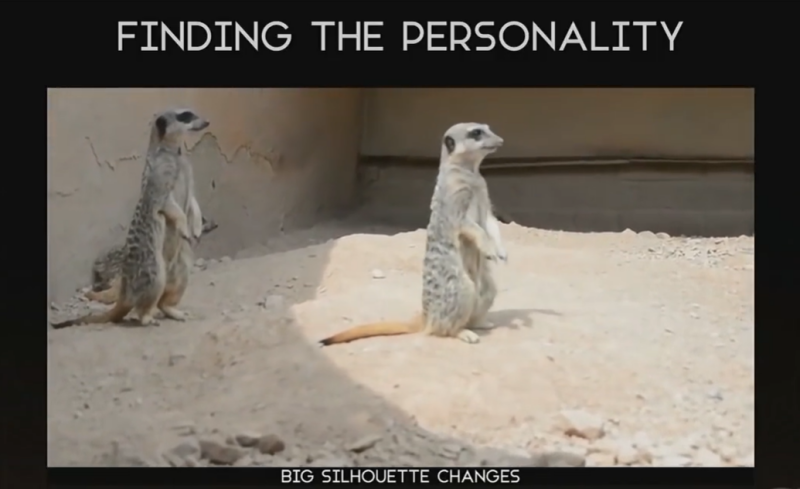

The next step was called the ‘Personality test’ which also called the ‘concept art in motion.’ It would be a short scenario clip with the aim to bring out the personality of the machine in its movement. Continuing from the example of the Watcher, its personality test compiled of lots of curious and jittery movements with the Watcher constantly repositioning to examine its surroundings with other models of the Watcher in the background to communicate the group behaviour.
This short clip quickly and easily translates the type of machine and its behaviour to the other animators. It was also effective in being able to help define the base poses of the robots which saved more development time as the animators didn’t have to work completely from ‘scratch’ when creating the actions and cycles. Another advantage to this method of pipeline was that the limitations and challenges of animating each machine were defined very early in the development allowing a lot of time for the models, rigs and game mechanics to be refined for the personality of the machine.
This pipeline of using real-life references, compiling live motion concepts is ultimately the reason for the massive success of Horizon universe. By putting the personality before aesthetics of the machines their designs are purposeful with intent for the movement and actions, they perform making the robots of Horizon feel undeniably alive.

Create Your Own Website With Webador